AI Took 100K Jobs. Here’s How to Start a Business After Being Laid Off.
Two numbers came across my desk this week, and I can’t stop thinking about them together. Through June of this year, 101,743 American job cuts named AI as the reason. That’s the first half of the year alone, so figure it’s over 200,000 by the time the ball drops. Depressing, right? Now the second number: 531,423 new business applications were filed in June. In one month. That’s a record. So while the headlines are all about who’s getting cut, something much bigger is happening quietly underneath. People are deciding to start a business after being laid off instead of waiting for the next pink slip. And I think they’re right.
Two Record Numbers in the Same Month
Think about what those two figures are telling you when you put them side by side. Amazon cut 16,000 corporate jobs in January. Oracle cut 21,000. Meta let 8,000 people go, Dell 11,000. Intuit cut 17% of its workforce. Block laid off nearly half the company. These aren’t struggling businesses. They’re some of the most profitable companies on earth, and they’ve figured out that AI does a lot of the work faster and cheaper.
But the people walking out of those buildings aren’t stupid. A programmer who just got replaced by software knows that if he takes another programming job, it’s only a matter of time before that company catches on too. So a lot of them are skipping the job hunt entirely. They still have the skills. They still have the experience. They’re taking both and building something of their own. Half a million of them in a single month.
Back in the 90s, when I was doing a lot of marketing work, there were only about 11 million businesses in the entire country. Add 500,000 a month to that base and you can see where this is heading. History is bending back on itself.
We Were All Entrepreneurs Once
Before the Industrial Revolution, every one of us was self-employed. You were the baker, the shoemaker, the blacksmith. That’s how people survived. Then the factories came along, and they needed employees, so they built a school system that taught people how to become employees. It never taught you how to work for yourself. It still doesn’t.
Now AI is taking over the mundane, systematic work, and that is pushing people back toward running their own show. I left the corporate world in 1995 and never went back. I’m watching a whole generation arrive at the same decision, only they’re being shoved through the door instead of walking through it. Either way, they’re through.
Which Jobs Are Going Away (and Why)
Here’s the pattern I’d ask you to look for: anything that runs on a system is going to be replaced.
Take what I call the systems coach. You bought a coaching program, opened the binder, and it told you the five questions to ask on every first call. Same five questions, every client. We don’t need you anymore. AI does that better. The coach we still need is the intuitive coach, the one who can tap in and feel what’s actually going on with the person across the table.
Bookkeeping is a system. It won’t be long before your accounting software produces the monthly reports, the tax return, and a note telling you where you’re overspending. A lot of legal work is a system. Book editing is a system. I’ve been using Photoshop since it came out in the 80s, and I hardly open it anymore. I describe the graphic I want and get something better than I could have made myself.
Remember “just learn to code”? Ten years ago that was the guaranteed path, with kids starting at $100,000 out of school. Now AI writes code better than most humans. I’ve done it myself: I needed a script for a website, asked for it, pasted it in, and it worked.
What AI Can’t Replace
So what’s left? Experience. Intuition. Judgment. AI has more information than you. You have more experience than AI. Those are not the same thing.
When AI hands me a graphic, I can say the color is wrong, the balance is off, try again. Someone with no design background will call whatever comes out good enough. When AI writes a sales letter, I can tell whether it will sell, because I’ve written hundreds and watched what happened. Someone who has never written one will think it sounds fine, spend money on it, and find out the hard way.
The tool is only as good as the person holding it. Your experience is the part nobody can download.
The Mini Business: How to Start a Business After Being Laid Off
The CEO of Perplexity used a phrase I liked: the mini business. Not a startup with a pitch deck and investors. A business that supports you and your family, built with tools that used to require a staff.
You could be a researcher. Businesses pay for market research, and they don’t care how you gathered it as long as it’s accurate and packaged well. You could set up AI receptionists for local companies. I’m building one right now for a client: a knowledge base, a voice, and suddenly the phone gets answered 24 hours a day with no salary and no workers’ comp. You could write and publish ebooks. You could teach AI to the people who are still afraid of it, and that market is going to exist for a decade, because there are a lot of them.
If you don’t know where to begin, here’s your first assignment. Open any AI model and type this: “I’m thinking about creating a mini business. I have no idea where to begin. I have skills and experience in these areas: [list them]. Can you make some suggestions about what I could do?” I guarantee it comes back with things you haven’t considered. My knowledge base is big, but it isn’t vast. AI is vast. Let it widen your field of view, then use your experience to pick.
The Mistake I Made in 2008
I need to tell you about the years I lost, because I don’t want you to lose yours.
When the economy turned in 2008, I watched my clients fall apart. More than half of my coaching clients walked away that year. Friends in the seminar business closed their doors. And I looked around and decided the smart move was to stop. Stop promoting, stop building, sit on the sidelines, and wait for things to improve.
Things did not improve in 2009. Or 2010. Or 2011. It was 2012, maybe 2013, before the market really caught again. I lost four or five years I could have spent building, and when spring finally came, the people who had kept working were miles ahead of me.
I grew up in Canada. I know what fourteen feet of snow looks like, and I know that when a storm dumps three feet on you overnight, it feels like the end of the world. It isn’t. Winter always ends. The question is whether you’re ready when it does. Some of the most successful businesses in history were started during the worst economic times, precisely because everyone else was waiting.
Fear, Loneliness, and the Human Element
Fear is going to be there. I’m not immune to it. What fear does to most people is shut them down. They pull back, stop spending, stop moving. You don’t have to be fearless to make progress. Some days the only thing you can manage is one email or a few notes. Fine. Some forward movement always beats none.
The other trap is quieter. George Pu, who runs a company called Founder Reality, cut his team from 14 people to 5 using AI and hasn’t hired in two years. He called it the best financial decision he ever made and the worst emotional experience. We are not built to work alone. Loneliness kills productivity. That’s why coworking spaces are booming and why masterminds keep getting more popular. So build the human part on purpose: a weekly Zoom with a few people swapping what they learned in AI this week, or a monthly lunch at somebody’s house. It’s cheap, and it’s the difference between a business that lasts and one that quietly fades.
Don’t Get Left Behind
I open my AI apps in the morning and there’s an update. By four in the afternoon there’s another one. We’re still on the ground floor, and the worst possible move is to decide you don’t want to know about it. People said that about computers in the 90s, right up until they were standing at a gas pump that wanted a card and had no idea what to do.
AI took work away from a lot of people. It took some of mine. But a record half million people just decided it also handed them the tools to build something new, and I’m betting on them. Stay strong, stay flexible, keep moving, and go build your future.
Want a head start? Grab my free download of 100+ ready-to-use AI prompts at renegade.club/110 – they work in ChatGPT, Claude, Gemini, or Grok. And listen to the full episode, “AI Took 100K Jobs, Now It’s Time to Build YOUR Future,” at RobertImbriale.com/listen.
Download This FREE Library AI Prompts that can save you 10 or more hours per week!
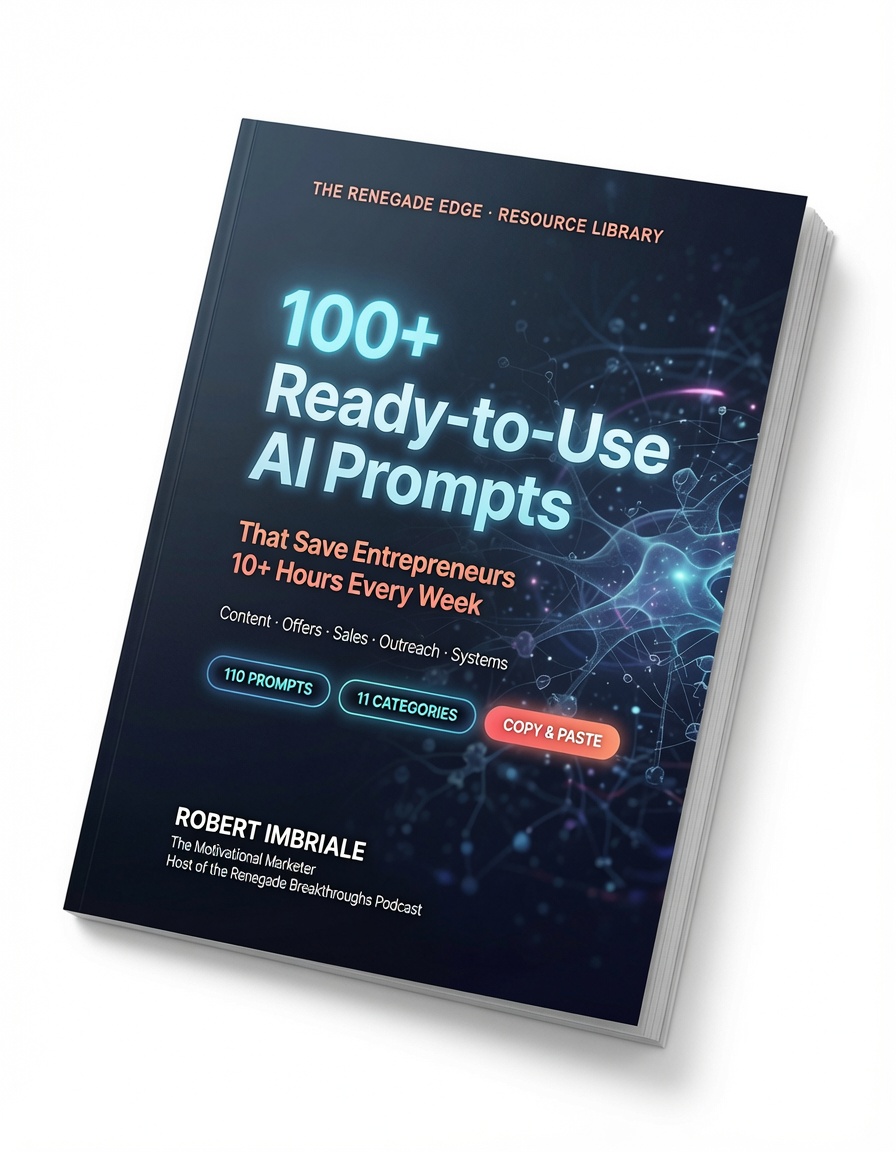
This is for you if you’re an entrepreneur, coach, consultant, or creator who:
– Wears too many hats and never has enough hours in the day
– Knows AI *should* be saving you time but hasn’t cracked how
– Would rather spend your energy on the work only you can do – not on writing every email, caption, and offer from scratch
If that’s you, this library was built for exactly where you are right now!
Free instant access. No credit card, no catch.
The post AI Took 100K Jobs. Here’s How to Start a Business After Being Laid Off. appeared first on Robert Imbriale.